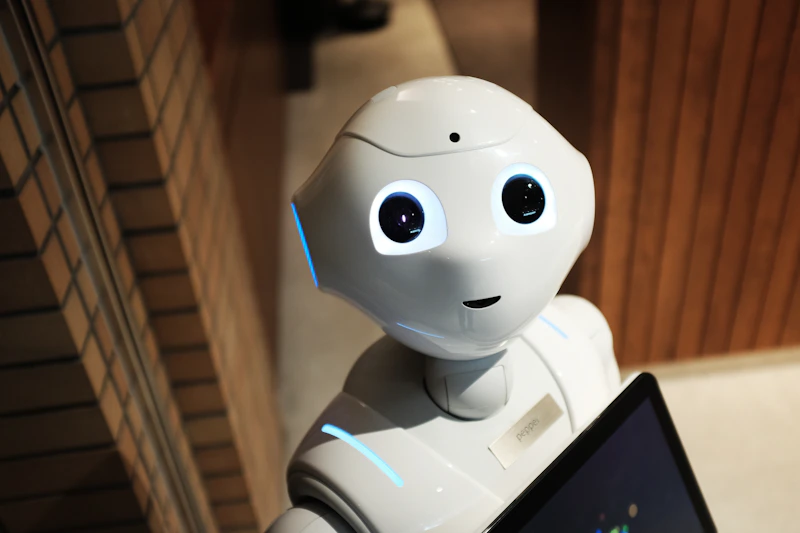
Source: Unsplash
Figure 02 spent ten months at BMW's Spartanburg plant, moved over 90,000 metal components, logged 1,250 hours on the floor, and helped build 30,000 cars. Not once did it complain about shift hours or ask for a pay raise. But the 400 human workers standing next to it? That's where the real design challenge lives.
Humanoid robots are entering industrial environments faster than anyone predicted, but the interaction design layer that makes them safe, trusted, and actually usable by human workers is dangerously behind. In 2026, Figure AI, Tesla, Unitree, and Boston Dynamics are scaling production while the humanoid robot market heads toward $6.24 billion this year alone. BMW has already proven the hardware works. What nobody's talking about: the product design of human-robot interaction is still an afterthought. And that is going to be a very expensive problem very soon.
"UX must be elevated from an afterthought to a strategic priority. It is about designing systems that make sense, feel safe, and invite participation, with companies prioritizing trust-driven design through testing with real users early, refining safety protocols, and ensuring intuitive control mechanisms."
— Interaction Design Foundation, Human-Robot Interaction Research, 2026
The Numbers Tell One Story. The Factory Floor Tells Another.
When Figure AI deployed 40 units of its Figure 03 robots at BMW's Spartanburg assembly plant in early 2026, the results were technically impressive. Greater than 99% placement accuracy per shift. An 84-second cycle time consistently met. Over 90,000 sheet metal parts positioned for welding across 1,250 operating hours. BMW then expanded the program to its Leipzig plant in Germany in February 2026, marking the first time Physical AI of this kind entered a European automotive production environment. From a pure output metric, it looked like a success story.
But here's what wasn't in the press releases.
40% of industrial workers today say they fear their job will be replaced by a smart machine. Research from the American Psychological Association found that proximity to automation induces measurable anxiety and decreased job satisfaction, even when jobs aren't actually threatened. And when you're working a ten-hour shift next to a 70-kilogram robot that can lift 12 kilograms per arm, moves at 1.2 meters per second, and has sensors pointed at you at all times... feelings get complicated fast.
The interaction layer between human workers and these machines is the unsexy, underfunded, underdesigned part of robotics that will determine whether this whole industrial wave succeeds or crashes into a wall of worker resistance, regulatory pushback, and very expensive liability claims. I'm surprised by how few people in the industry are treating it as a serious design problem.
The Interface Problem Is Bigger Than Anyone Admits
Every product designer I know has spent years thinking about digital interfaces. Screens. Flows. States. Error messages. We've built sophisticated mental models for how users interact with software systems. The whole discipline of UX was built around reducing cognitive load, communicating system state clearly, and making the next step obvious to the human on the other end.
Now imagine your "user" is a 1.7-meter machine that moves at speed, has no face you can read, communicates nothing about its next action, and can cause serious physical harm if you misread its intent. That's the humanoid robot UX problem.
These robots have no legible affordances in the traditional UX sense. A button signals it can be pressed. A hyperlink signals it can be clicked. A humanoid robot standing on a factory floor signals... what exactly? That it's about to turn? That it's about to pick up the part sitting two inches from your hand? That its proximity sensor detected you and it has already begun its stopping sequence?
I've written about invisible interface problems before on Medium, specifically around AI systems that make decisions the user can't observe. The challenge there was rebuilding trust in software that acted on data the user couldn't see. Here, the stakes are physical, the consequences are immediate, and the human is standing close enough to get hurt.
A concrete and very public example landed in April 2026. A humanoid robot at a university event in Shaanxi, China, suddenly turned and hugged a female performer during a choreographed routine. The AI misread a gestural cue. No one was seriously hurt, but the incident went globally viral and sparked a real debate about safety in public-facing human-robot interaction. The robot didn't malfunction from an engineering standpoint. It functioned exactly as designed. The design just hadn't accounted for ambiguous human context. That is not an engineering failure. That is a product design failure.
What the SaaS World Can Teach Robotics (and What It Can't)
I've been building enterprise SaaS products for eight years. The biggest lesson I've carried into every AI-native product I've designed is this: trust is an interface element, not just a feeling.
When we design SaaS systems that automate decisions on behalf of users, we spend enormous effort on explainability. Why did the system do that? What is it about to do? Can the user intervene? We build confidence indicators, audit trails, override mechanisms, and undo states. These aren't nice-to-haves. They're the difference between users trusting the system and quietly abandoning it. I went deep on this in my AI readiness framework at reloadux, where the core argument was that most enterprise teams are trying to integrate AI into products without first designing for the trust and transparency layer.
Humanoid robots need the exact same thing. And right now, almost none of them have it.
Look at how BMW's Figure 02 deployment was designed. The robot retrieved and positioned metal parts. Technically a well-scoped task. But the human workers near it had no real-time visibility into what the robot was "thinking" at any point. They learned to read the robot's physical behavior through observation over time, through weeks of shared proximity. That's not design. That's forced adaptation. And it places the entire cognitive burden on the human to build a mental model of an opaque autonomous system.
When we design systems that force humans to adapt to the machine instead of designing the machine to communicate clearly to humans, we've failed at the most fundamental job of product design.
Five Things Robots Need to Borrow from Good UX Design
I want to get specific here, because "humanoid robots need better UX" is easy to say and hard to act on. Here are five concrete principles, drawn directly from digital product design, that every robotics team should be working with right now:
- Status transparency at all times: Robots need always-on signals communicating their current mode, whether that's executing a task, paused, in an error state, or in standby. Think of it like a loading spinner or a status bar. The human worker nearby should never have to guess whether the machine is active or idle.
- Intent signaling before every action: Before a robot moves, it should broadcast its next action via a clear light pattern, directional indicator, or projected path. This is basic affordance design applied to physical 3D space. It's the equivalent of a button changing color on hover, but for a machine that weighs as much as a person.
- Override and escalation interfaces that are obvious: Every worker in proximity to a robot should have a simple, unmissable way to pause or redirect it. Not buried in a control panel interface. A single physical button, with clear color coding, within arm's reach. Designing this as an edge case instead of a primary use case is a serious mistake.
- Failure communication in plain language: When a robot can't complete a task, it should communicate why in terms a floor worker can understand, not an error code that requires a trained technician to interpret. Plain-language failure states are a solved problem in software. We need to apply that solution to physical systems.
- Structured onboarding for every human worker in proximity: Just like good enterprise SaaS has onboarding that builds accurate mental models gradually, new workers assigned to robot-adjacent tasks need structured orientation before their first shift. Not a safety video. A designed experience that builds the right intuitions.
None of these are technically complex. All of them require product designers to be in the room when robots are being designed and deployed. And right now, based on what I'm observing across the industry, they mostly aren't.
The Market Is Moving Faster Than the Design Discipline
Here's the part that genuinely concerns me as a practitioner.
The humanoid robot market is expected to reach $251 billion by 2035, according to SNS Insider research published in early 2026. Tesla is planning to reveal Optimus V3 later this year with 37 joints and a target consumer price of $20,000 to $30,000. Figure AI is producing one new robot every 90 minutes at its BotQ facility. Unitree and AgiBot are scaling rapidly across Asia, which already commands 55% of global humanoid robotics deployment. Bank of America's 2026 analysis puts current unit costs at $90,000 to $100,000, with a clear path to consumer price points within this decade.
UBS projects the total market hitting $30 to $50 billion by 2035 and potentially $1.4 trillion by 2050. That is an enormous surface area of human-robot interaction, spanning factories, hospitals, homes, schools, warehouses, and public spaces. Every one of those contexts involves humans who need to understand, trust, and safely coexist with these machines.
If we don't build a serious design discipline around human-robot interaction now, we're going to spend years doing damage control the way the social media industry spent years realizing it had designed for engagement at the expense of human wellbeing. The pattern repeats. Technology moves fast. Design follows late. Users pay the price.
What I Think Happens Next
The companies that win in humanoid robotics over the next five years won't just be the ones with the best actuators or the most capable multimodal LLMs in the control stack. They'll be the ones that figure out the human layer. The companies that get design right will deploy faster, face less regulatory friction, experience fewer incidents, and build the kind of worker trust that makes scaling possible.
I've been designing AI-native experiences long enough to know that the technical interface is rarely the hardest part. The hard part is designing for trust in systems that operate with partial information, make autonomous decisions, and exist in contexts where the cost of error is high. I wrote a full piece on this framework at reloadux, and the core lesson transfers directly here: you can't bolt trust onto a product after you've built it. You have to design for it from the start.
Figure AI should be hiring product designers and HRI specialists the way it's hiring robotics engineers. BMW should be running design research alongside its technical pilots, not after them. Every serious robotics company scaling into environments with human workers should treat interaction design as a core competency, not an afterthought bolted on at the end of an engineering sprint.
The robots are here. The question is whether we're going to design their interaction layer with the same rigor we give a mobile app onboarding screen. Spoiler: we should be giving it significantly more. The stakes are higher. The margin for error is narrower. And the humans involved didn't get to choose whether to opt in.
What do you think? Drop your thoughts in the comments below. Are you seeing this play out in your own industry? I'd love to hear from people working in manufacturing, robotics, or enterprise product design. What does good human-robot interaction look like on the ground?
Sources:
1. Figure AI production at BMW — figure.ai/news/production-at-bmw
2. BMW Group humanoid robot Leipzig deployment — press.bmwgroup.com
3. Humanoid Robot Market Size 2026 to 2035 — SNS Insider via globenewswire.com
4. IxDF Human-Robot Interaction research 2026 — ixdf.org
5. Robot incident at Shaanxi university — globaltimes.cn
6. UBS and Deloitte humanoid robot projections — iiot-world.com
7. Bank of America unit cost analysis 2026 — lumichats.com
8. Worker automation anxiety research — APA and Colorado State University