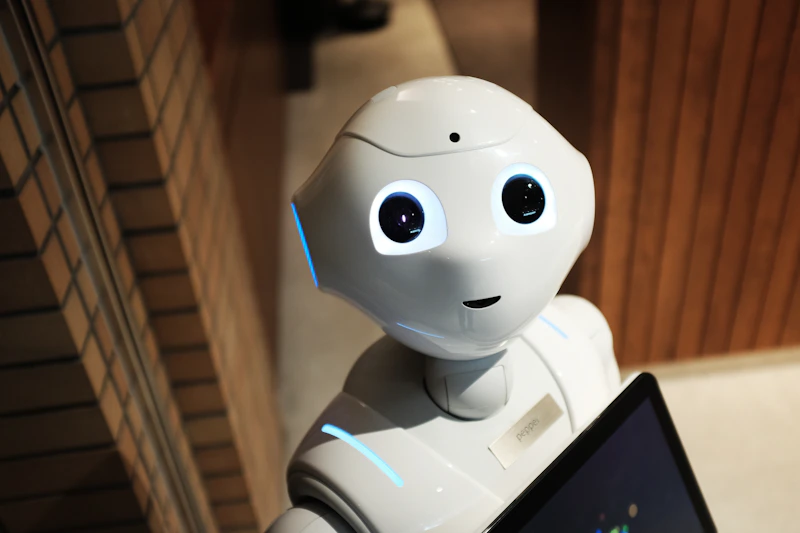
Source: Unsplash
Humanoid robots are already working on factory floors at BMW and Hyundai. They are sorting battery cells in Tesla's facilities. They are handling packages in Amazon warehouses. And the human workers standing next to them have no idea how to communicate with them, trust them, or recover when they fail. That is a design problem. And nobody hired a designer to solve it.
The humanoid robot market hit $3.93 billion in 2026 and is on a trajectory to reach $38 billion by 2034. Figure 03 is running production tasks at BMW's Spartanburg plant after Figure 02 completed a pilot handling over 90,000 parts across 1,250+ operational hours. Boston Dynamics is ramping Atlas deployments across Hyundai facilities, with a factory capable of producing 30,000 robot units per year. Tesla is converting part of its Fremont, California facility to Optimus production in 2026. The hardware is shipping. The deployment timelines are real. But here is the thing nobody is writing about: when a humanoid robot walks onto a factory floor and stands next to a human worker, what is the interface between them? Who designed it? What principles govern it? I have been building product interfaces for 8+ years and the honest answer is that this interaction layer is the most under-designed thing in the most over-hyped technology category of our time.
"The project team's early communication ensured transparency from the outset and promoted acceptance, and the deployment of humanoid robots was met with great interest among employees and quickly became a natural part of everyday work."
— BMW Group, on the first humanoid robot pilot at BMW Plant Leipzig, 2026
That BMW quote is interesting. Not because of the optimism in it, but because of what it reveals by accident. "Early communication" and "transparency" are the things BMW credits for worker acceptance. In other words, the human communication design around the robot mattered more for adoption than the robot's actual capabilities. That is a product insight that most robotics companies are burying in press releases while they talk about dexterity benchmarks.
What Is Actually Happening Right Now on Factory Floors
Let me put the current reality in plain terms. As of mid-2026, humanoid robots are in the low thousands globally. They are doing real production work, not just demos. But the scale is still limited and the tasks are intentionally simple: moving parts from point A to point B, handling components in constrained environments, filling in on physically demanding or repetitive tasks that cause injury over time in human workers.
BMW is frank about this. One executive noted: "A robot jumping into a moving car and assembling parts, I cannot see this in the near future." This kind of honesty is rare in the robotics space and it is exactly right. The hardware is impressive. But fine motor control, real-time decision-making in unpredictable environments, and fluid collaboration with human coworkers remain significant unsolved problems. The robots that exist today work best in structured, controlled environments with limited variability.
The practical constraints are real too. Figure 02 operates for roughly 2-3 hours of active use before needing a recharge. Tesla Optimus Gen 2 is estimated at 4-5 hours. ISO safety standards specifically for humanoid robots are still being drafted, with finalization likely years away. Formal certification frameworks for human-robot coexistence on production floors are still works in progress.
And yet the robots are already there, working alongside humans, right now.
The Interface Problem Nobody Is Designing For
Here is where I want to slow down and actually think through what is happening from a product design perspective. When I design a software product, I am designing how a human interacts with a system through a screen, a voice interface, or a set of gestures. The interface is the translation layer between human intent and machine action. It has to be legible, predictable, and recoverable.
A humanoid robot working alongside a human worker on a factory floor is also a translation layer. But the interface is not a screen. It is the robot's body, its movements, its proximity, its timing, its signals. Every movement a humanoid robot makes is an interface event. When the robot reaches for a part, it is communicating intent. When it pauses, it is communicating a state change. When it stops, is that a completed task or an error? The human worker standing one meter away needs to read all of this, in real time, while doing their own work, without a manual.
The most important interface design in humanoid robotics right now has nothing to do with software. It is the physical communication layer between machine and human, and almost nobody is treating it as a design problem.
Five Design Problems That Humanoid Robotics Has Not Solved
- Intent communication before movement: In human-to-human collaboration, we signal intent constantly through micro-gestures, eye contact, and body language before we act. Humanoid robots have no established vocabulary for this. When a robot arm swings toward a shared workspace, the human next to it has no warning signal to read. This is not a safety issue alone. It is an interaction design failure that erodes trust over time, regardless of whether an accident happens.
- Error state legibility: When a robot fails mid-task, what does that look like? A system that just stops is ambiguous. Did it complete the task? Is it waiting for input? Is it broken? In software, we solve this with error messages, spinners, empty states, and failure screens. In physical space, these design patterns do not exist yet. The human worker has no reliable way to read robot error states without deep training or an app overlay, and neither is a sustainable solution at scale.
- Shared workspace negotiation: Human workers negotiate shared physical space constantly and unconsciously. When two people reach for the same tool, one pauses and gestures for the other to go first. Robots cannot do this yet at a level of social fluency that feels natural. The result is that human workers adapt to the robot, not the other way around. The human becomes the error handler for the system's design gap. That is bad product design by any definition.
- Trust calibration over time: User studies show that workers accept humanoid robots most readily when they mirror average adult stature and move predictably. But trust is not binary. It builds or erodes over dozens of interactions. A robot that behaves consistently earns trust. One that occasionally stutters, hesitates, or does something unexpected loses it fast. The design challenge is creating the behavioral consistency and predictability that trust requires, which is a UX problem dressed up as a robotics problem.
- Onboarding for non-technical workers: The workers who interact with humanoid robots most on factory floors are not engineers. They are skilled tradespeople, assembly workers, logistics staff. The onboarding experience for working with a humanoid robot cannot require a tablet tutorial or a training manual. It needs to be ambient, observable, and learnable through demonstration. Nobody has designed this yet.
The Uncanny Valley Is Not Just an Aesthetic Problem
The uncanny valley has been discussed for decades as an aesthetic issue. Make a robot too human-looking and people feel unsettled. Make it clearly robotic and people are fine. But I think the uncanny valley has a functional dimension that gets ignored. When a robot looks human but does not move like a human, it breaks a set of predictions the brain uses to anticipate physical behavior. And broken predictions in shared physical space are dangerous. They cause workers to misjudge where the robot will move next, how fast, and with how much force.
The uncanny valley is a trust failure, not just a design aesthetic failure. And fixing it requires more than making the robot look less human. It requires designing movement patterns, pacing, and behavioral cues that set accurate expectations. That is motion design applied to physical systems. It is a field that barely exists yet as a formal discipline.
What the Smart Companies Are Getting Right
BMW's approach is worth studying because it hints at the right instinct even if it is not fully formalized. They invested in communication before deployment. They briefed workers. They created context. The robot's physical presence was preceded by a social and informational design layer. That is user research and change management applied to robotics deployment. It worked. Workers at BMW Plant Leipzig described the robot as quickly becoming "a natural part of everyday work." That outcome is not accidental. It is the result of treating deployment as a design and communication problem, not just an engineering problem.
I have explored similar dynamics in my AI-native UX work on Medium, where I argued that AI integration fails most often at the interface layer, not the model layer. The same pattern holds here. The robots work. The AI that powers them works reasonably well for constrained tasks. The failure point is the interaction design, and specifically the gap between what the system can do and what the human standing next to it can understand, predict, and trust.
What Product Teams and Designers Should Be Paying Attention To
If you are building in the robotics space or adjacent to it, here are the questions that matter from a design perspective right now.
How do you design physical behavioral cues that communicate robot state to a human with zero cognitive overhead? How do you create a shared workspace protocol that does not require training? What does graceful degradation look like when a robot fails mid-task in a live production environment? How do you build a calibration system that adapts to individual human workers, not just to the task? And how do you measure trust as a design metric, not just as a sentiment score on a survey?
These are not robotics engineering questions. They are product design questions. And the robotics companies that figure them out first will have a structural advantage that is much harder to copy than hardware specs.
The $38 billion humanoid robot market will not be won by the company with the best actuators or the longest battery life. It will be won by the company that designs the most legible, trustworthy, and natural interface between human worker and machine. That company has probably not thought of itself primarily as a design company yet. It should.
At reloadux, we have been tracking how AI and automation change the interface requirements for enterprise products. The humanoid robot category is the most physical expression of that shift, and it is happening faster than most design teams have noticed.
Are you working in a space where humans and robots interact? Have you seen this problem up close or thought through how you would design for it? I genuinely want to hear from practitioners on this. Drop your take in the comments below.
Sources:
1. Humanoid Robots Enter the Workforce: Figure AI, Tesla Optimus, Boston Dynamics 2026 — GrabaRobot — https://www.grabarobot.com/blog/humanoid-robot-workforce-deployment-2026/
2. BMW Group Deploys Humanoid Robots in Germany for First Time — BMW Group Press — https://www.press.bmwgroup.com/global/article/detail/T0455864EN/
3. Humanoid Robot Market Size 2026-2034 — Fortune Business Insights — https://www.fortunebusinessinsights.com/humanoid-robots-market-110188
4. Humanoid Robots Challenges 2026 — RoboZaps — https://blog.robozaps.com/b/challenges-in-humanoid-robotics
5. Boston Dynamics Atlas Production — The Register, Jan 2026 — https://www.theregister.com/2026/01/06/boston_dynamics_atlas_production/
6. Tesla Optimus Robot 2026 — Standard Bots — https://standardbots.com/blog/tesla-robot
7. Humanoids Market Size 2026-2031 — Mordor Intelligence — https://www.mordorintelligence.com/industry-reports/humanoids-market