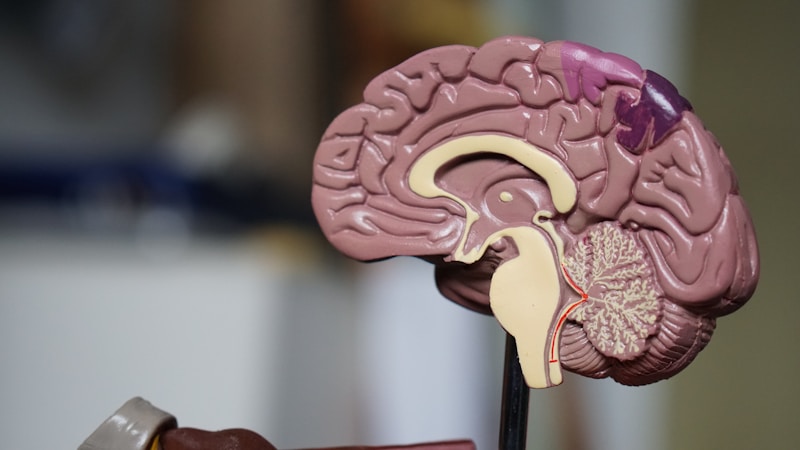
Source: Unsplash
The hardware is shipping. The interaction model is not.
Neuralink is moving to high-volume production of brain-computer interfaces in 2026, with 21 patients implanted worldwide as of January and a fully automated surgical robot replacing humans for the procedure. The brain-computer interface market is projected to hit $3.33 billion this year and $13.86 billion by 2035, growing at a 16.77% CAGR according to Precedence Research. Here is what most coverage misses. The bottleneck for BCIs is not the chip, the threads, or the surgery. It is the user interface. After eight years of designing 42 products across enterprise SaaS, fintech, healthcare, and now AI native interfaces, I can tell you the discipline of thought based UX barely exists yet. Companies are about to ship millions of devices into a design vacuum.
"I am typing this with my brain. It is my primary communication."
— Brad Smith, Neuralink's third patient, 2025
Brad Smith has ALS. Before his implant he could not speak. Now he is editing video, controlling a computer, and posting on X with his thoughts. The third patient on the planet to do this. Kenneth Shock, who got his chip in January 2026, was up and running within weeks. That speed of adaptation is the part the press releases miss. The hardware is impressive, but the interaction patterns are still being invented in real time, by people whose lives depend on figuring it out.
What "User Interface" Even Means Without a Screen
Pull up any UX textbook from the last 30 years. Click targets. Hover states. Affordances. Visual hierarchy. Error messages. None of those exist when the input device is your motor cortex. Every conventional rule about how humans interact with software falls apart the moment you remove the screen and the keyboard.
Noland Arbaugh, the first Neuralink patient, described the early experience as "like remembering a dream." He said the implant did not just give him a new way to use a computer. It gave him a new way to live. That phrase is more than poetry. It is a design observation. The interface is not between the user and the system anymore. The interface is the user. There is no boundary to design around.
This breaks how product teams have been trained to think. We separate users from products. We test usability by watching someone struggle with a flow. We measure clicks and time on task. None of that survives contact with a system that reads thoughts directly. The unit of analysis changes from "user plus interface" to a single coupled system that learns and drifts together.
The Calibration Problem Nobody Wants to Talk About
Most BCI coverage skips over this part because it is unglamorous. But it is the core UX problem. Every BCI requires per user calibration. The brain is not a stable signal source. Neurons shift, electrodes drift, the user's intent itself changes shape over time. The system has to relearn the user, and the user has to relearn the system, on a continuous basis.
The challenges that show up in clinical trials and academic literature are not exotic. They are the same UX problems we already deal with on screens, just amplified to a brutal degree:
- Signal noise: Cleaning electrical interference is a UI problem because users notice latency. A 200 millisecond delay between intent and action breaks the illusion of control.
- Calibration drift: The brain rewires itself. The model has to relearn the user every session, sometimes mid session. Imagine if your mouse cursor required recalibration every Tuesday.
- Real time feedback: A BCI operates silently. Users cannot tell if a thought registered, was misread, or got dropped. There is no equivalent of the click sound. No equivalent of the cursor blink.
- Mode switching: How do you "right click" with your mind? How do you tell the system "this thought was just me daydreaming, do not act on it"? These are open product problems.
- Privacy boundaries: What counts as a deliberate command versus a passing thought? The line between intent and ideation is not philosophical anymore. It is a feature spec.
If you cannot see, hear, or feel the system, every product decision becomes an act of trust. That is the underlying truth of BCI design, and it is also why the discipline is going to take a decade longer than the hardware roadmap suggests.
The Trust Gap That No Onboarding Flow Can Fix
In December 2025, Neuralink hired David McMullen, a former FDA executive, as its head of medical affairs. The framing was that he would bridge clinical, research, and regulatory work. The subtext was something else. Trust is the bottleneck. Users are putting hardware inside their bodies. They cannot inspect the firmware. They cannot read the changelog. They cannot uninstall the app.
I have spent years designing fintech and healthcare products where trust is also a UX layer. People hand you their money or their medical history. The patterns we use, transparent error states, undo affordances, clear explanations of what the system is doing and why, are all premised on a screen. Take the screen away and most of those tools stop working. There is no privacy modal you can show inside someone's skull.
That is why the framing of "BCI as a medical device" is going to break. A pacemaker does not need a UX strategy because it does not need to interpret intent. A BCI does. The moment you start asking the brain to act as an input source, you are building a product, not just a treatment. And products require interface decisions. Lots of them.
Lessons From the AI Native Shift, Applied to BCIs
I wrote about this on Medium a couple of weeks ago in a piece called "How to Build AI-Native Experiences: 14 Mindset Shifts for Product Teams." The core argument was that AI native interfaces require teams to abandon deterministic thinking. You cannot map every input to a fixed output anymore. You have to design for probability, for ambiguity, for systems that get it wrong sometimes.
Brain computer interfaces are the extreme version of that exact shift. Every BCI is a probabilistic system. Every command is an inference. Every action carries a confidence score that the user never sees. Product teams that have been trained to think in terms of "the button does X" have to relearn the entire toolkit.
The mindset shifts I have been arguing for in conventional AI native UX, treating confidence as a first class UI element, designing recovery flows that are more robust than the happy path, building intent surfaces that the user can correct, all of those compound when the input is a thought instead of a tap. We explored some of this at reloadux when we shipped the AI Readiness Framework in March. The same five readiness dimensions apply here. Data foundations. Mental models. Trust loops. Recovery patterns. Measurement. BCIs make the framework load bearing instead of optional.
What Product Teams Building "Normal" Software Should Learn
Most readers of Info Planet are not building neural implants. You are building SaaS dashboards, mobile apps, internal tools. The reason BCIs matter to you is that they are the canary for where input is going. Voice was the first crack. Gesture was the second. Eye tracking was the third. Thought is the fourth. Each step removes more of the explicit interface and forces designers to read intent from increasingly noisy signals.
The teams that figure out probabilistic UX on screens today will have a head start when the inputs go off screen. The teams that keep treating their products as "click the button to do the thing" will struggle to adapt. Sabi, a startup challenging Neuralink with a non invasive BCI hat that aims to write thoughts directly to a computer, is a sign of how fast this is moving outside of medical contexts. Consumer hardware is not waiting for the regulatory dust to settle.
If you take one thing from this article, take this. The next decade of product design is about reading intent from imperfect signals and giving users a way to correct course gracefully. That is true whether the signal is a half typed search query, an ambiguous voice command, or a flicker of activity in the motor cortex. The companies that get good at it across all of those modalities are the ones that will own the next platform.
What do you think? Drop your thoughts in the comments below. I would love to hear how you are seeing this play out in your own work, especially if you are designing for AI native or multimodal inputs.
Sources:
1. Fox News — Neuralink to start high volume production in 2026 (foxnews.com/health/elon-musk-shares-plan-mass-produce-brain-implants-paralysis-neurological-disease)
2. Fortune — Noland Arbaugh interview, 18 months after implant (fortune.com/2025/08/23/neuralink-participant-1-noland-arbaugh-18-months-post-surgery-life-changed-elon-musk)
3. Precedence Research — Brain Computer Interface Market Size (precedenceresearch.com/brain-computer-interface-market)
4. STAT News — Neuralink's big vision collides with reality (statnews.com/2026/01/05/neuralink-brain-computer-interface-medical-device-vs-transhumanism)
5. Roic News — Neuralink expands trial to 21 participants worldwide (roic.ai/news/neuralink-expands-brain-computer-interface-trial-to-21-participants-worldwide-01-28-2026)
6. Built In — How to Design Products for the Brain (builtin.com/articles/design-products-brain-computer-interface)
7. Frontiers — Neuralink medical innovations and ethical challenges (frontiersin.org/journals/human-dynamics/articles/10.3389/fhumd.2025.1553905/full)