Source: Unsplash
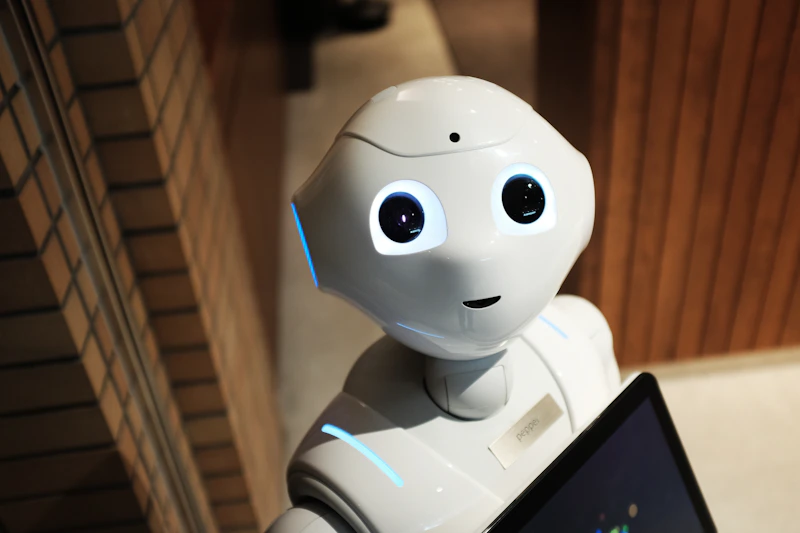
There are humanoid robots working on factory floors right now. Real ones. At BMW. At Mercedes. Inside Tesla's own production lines. They lift things, carry parts, sort components. And the people responsible for those facilities are figuring out how to work alongside them using... mostly nothing. A tablet here. A walkie-talkie there. A vendor engineer sitting nearby with a laptop.
This is the part of the humanoid robot story that nobody is writing about. The global humanoid robot market is valued at roughly $4-5 billion in 2026 and is projected to hit $40.5 billion by 2033, growing at a CAGR of 38 to 52% depending on which research firm you ask. Figure AI has 40 robots deployed at BMW's Spartanburg plant right now, billing at around $25 per robot-operating-hour. Tesla has converted its Fremont factory lines, previously used for Model S and Model X, to build Optimus units. We are past the prototype phase. Humanoid robots are entering the real world. And we have almost no design language for how humans are supposed to interact with them.
"I'm watching AI in a human body do human work. And it's early. We don't have thousands of robots yet. We have hundreds now, but we need millions of robots to make an impact."
— Brett Adcock, CEO of Figure AI, 2025
Brett Adcock is right that we need millions. But before we get to millions, we need to answer a question that hardware engineers are not asking: What is the interface? Not the interface between the robot's brain and its motors. The interface between the robot and the human working next to it. The floor manager who needs to redirect 40 robots when a parts shipment is delayed. The worker who needs to signal that a robot is in her way. The safety lead who needs to pull an entire fleet offline in 30 seconds. These are product design problems. And right now, nobody is solving them.
What the "Interface" Looks Like Right Now
If you go looking for how workers actually interact with humanoid robots in 2026, the picture is not what the press releases suggest. Most of what's happening on real factory floors is more raw than the demos. According to deployment guides from companies like Axis Intelligence and research from the IEEE, current commercial deployments share a few uncomfortable traits:
- On-site vendor engineers: Most deployments require vendor engineers physically present to manage the robots. This is not a scalable model. It means the "user" of the robot is not the factory worker. It's a robotics PhD sitting nearby with a custom dashboard that nobody else knows how to read.
- Semi-segregated zones: Robots are not working shoulder-to-shoulder with humans yet. They operate in cordoned-off areas with limited human proximity. The interaction design question of "how does a human tell a robot to stop, move, or change tasks" is being avoided by keeping them separate.
- No standardized command layer: Tesla Optimus, Figure 03, Unitree H1, 1X NEO. These robots have entirely different control systems, different APIs, different operator interfaces. A factory running two different robot brands is running two completely separate paradigms for human interaction.
- Status communication is primitive: Most robots communicate their status through basic LED indicators or screen displays. There is no shared vocabulary. Does a yellow light mean "low battery" or "task paused" or "proximity alert"? Every manufacturer decides differently.
- Emergency protocols are manual: Pulling a robot offline often requires someone who knows the vendor's specific kill switch procedure. This is a design failure with real safety consequences.
This is where we are. The robots are real. The interface to operate them at scale is not.
Why This Is a Design Problem, Not a Hardware Problem
I've spent the last few years designing AI-native interfaces for enterprise products. And the pattern I keep seeing repeated in humanoid robotics is the same one I see in early-stage AI SaaS: the engineering team builds the capability, then treats the interface as an afterthought. In software, this produces features that technically work but that nobody uses because they're buried under confusing menus. In humanoid robotics, this produces a $25,000 machine that requires a specialist to operate, parked in a corner of a BMW plant while everyone figures out what to do with it.
The hardware challenge in humanoid robotics is getting easier, fast. Actuator costs are falling. Vision models are improving dramatically. Battery density is up. But the human layer, the part where a real worker with real cognitive load needs to understand what a robot is doing, request changes, and trust the system enough to actually work alongside it, that part is getting almost no serious design investment.
I wrote about a similar pattern on Medium when discussing AI-native experiences. The teams that succeed with AI products are not the ones who built the smartest model. They are the ones who figured out the right interface layer first. A robot that can carry 20kg of parts is useful. A robot that a floor supervisor can direct, monitor, and correct in 10 seconds without vendor support is transformative.
Source: Unsplash
Three Layers of HRI That Nobody Is Building
Human-Robot Interaction (HRI) as a field has existed in academia for decades. But academic HRI and the practical, messy, real-time interaction design that a factory floor demands are very different things. Here is where I see the three biggest gaps right now:
Layer 1: The moment-to-moment command layer. This is the "I need to tell this robot to move right now" interface. On a factory floor, this cannot require a touchscreen menu, a login, or a vendor app. It needs to be something a worker can do in one gesture, one voice command, or one physical signal. The design of this layer needs to account for workers who are wearing gloves, working in loud environments, and who are not tech natives. Nobody is designing this for the people who will actually use it.
Layer 2: The fleet management dashboard. When you have 40 robots on a floor (like at BMW Spartanburg), you need an interface that lets a shift manager see the status of every robot at a glance, reassign tasks, flag exceptions, and pull units offline. This is a product design problem that looks a lot like air traffic control. It requires spatial awareness, real-time status communication, priority queuing, and one-click emergency protocols. The current state of the art is vendor-specific dashboards that are built by engineers for engineers.
Layer 3: The robot-to-human communication layer. This one is underappreciated. The robot also needs to talk back. When a robot pauses because it hit an edge case in its vision model, the human nearby needs to understand why. Not with a cryptic LED color. With something that communicates intent. Boston Dynamics Spot uses audio cues and basic body language effectively. But most humanoid deployments have no consistent design language for what the robot is "saying" with its posture, movement, or status indicators.
The gap between what humanoid robots can do mechanically and what humans can understand about what they're doing is the real adoption barrier in 2026. Not the cost. Not the AI. The interface.
What Every Other Interface Transition Taught Us
We have been here before. Every major computing platform transition created an interface problem that hardware engineers underestimated and designers eventually solved.
When computers moved from mainframes to desktops, the interface problem was: how does a non-programmer interact with a machine? The answer was the graphical user interface. When smartphones arrived, the interface problem was: how do you use a computer with one thumb, no mouse, and no physical keyboard? The answer was capacitive touch and app paradigms that took years to mature. When conversational AI arrived, the interface problem was: how do you talk to software that talks back? We are still solving that one.
Humanoid robots are the next transition. The interface problem is: how do humans and autonomous physical agents share the same space and accomplish work together? This is a new category. And unlike previous transitions where the interface could evolve over software updates, the humanoid robot interface has physical consequences. A miscommunication between a worker and a robot is not a failed Slack message. It can be a safety incident.
The pressure to get this right is different. And the urgency is now, not in 2028 when the market has matured. The companies that define the interaction language for humanoid robots in the next 18 months will shape the entire industry's defaults, just like Apple shaped touch interface norms with the original iPhone and every Android OEM followed within two years.
Five Things Product Teams Need to Start Thinking About Now
I am not writing this as a journalist reporting from the sidelines. I build products. Here is what I would be working on if I were designing the human layer for a humanoid robot deployment today:
1. Context-aware command design. The same command cannot work the same way across a hospital room, a factory floor, and a logistics warehouse. The interface layer needs to understand deployment context and adapt. A gesture that means "stop" in a loud factory is different from a voice command that works in a quiet hospital ward.
2. Progressive trust mechanics. Humans do not trust new systems immediately. And they should not. Good HRI design needs to build trust incrementally. Start with highly supervised, highly transparent operation where the robot explains every action before taking it. Gradually move toward more autonomy as the human-robot relationship matures. This is not a new idea in UX. It is just not being applied here yet.
3. Standardized robot body language. The design community needs to push for an open standard for how humanoid robots communicate state through movement and light. This is like pushing for consistent iconography in early operating systems. It feels like overhead until you have ten different robot brands on one floor and workers need to interpret ten different "vocabularies."
4. Failure mode design. This is the most ignored part of product design and it is especially dangerous in physical AI. What does the robot do when it does not know what to do? The answer cannot be "freeze in place" or "revert to a default behavior that nobody around it understands." The failure mode needs to be as designed as the success mode.
5. Non-expert fleet management. A shift manager at a BMW plant is not a robotics engineer. The fleet management interface for 40 humanoid robots needs to be as approachable as managing a team in Slack. Status at a glance. One-tap task reassignment. Clear exception handling. If it takes more than a week of training, the interface has failed.
The global deployment of humanoid robots is accelerating. We are going from 16,000 units in 2025 to a projected 100,000 cumulative by 2027. That growth curve is going to hit a wall if the interaction design does not catch up to the hardware capability. The robots can do the work. The question is whether the humans around them can actually direct, trust, and work alongside them effectively.
That answer is entirely a design problem. And right now, the field is wide open.
What do you think? Are you working in a facility that is piloting humanoid robots? Have you seen the interface problem up close? Drop your thoughts in the comments below. I'd genuinely love to hear what the reality looks like from the floor.
Sources:
1. Figure AI deployment data and Brett Adcock quote — LumiChats Humanoid Robot Guide 2026 (lumichats.com)
2. Humanoid robot market size data — MarketsandMarkets, Fortune Business Insights, Research Nester (2026 reports)
3. BMW Spartanburg Figure AI deployment — New Market Pitch, Figure vs Tesla tracker (newmarketpitch.com)
4. Tesla Optimus factory conversion — BotInfo AI Tesla Optimus analysis (botinfo.ai)
5. State of Robotics 2026 Report — Robotics Center of Silicon Valley (roboticscenter.ai)
6. IEEE survey on humanoid robots — The Robot Report (therobotreport.com)
7. Humanoid robots in manufacturing 2026 — EVS International (evsint.com)