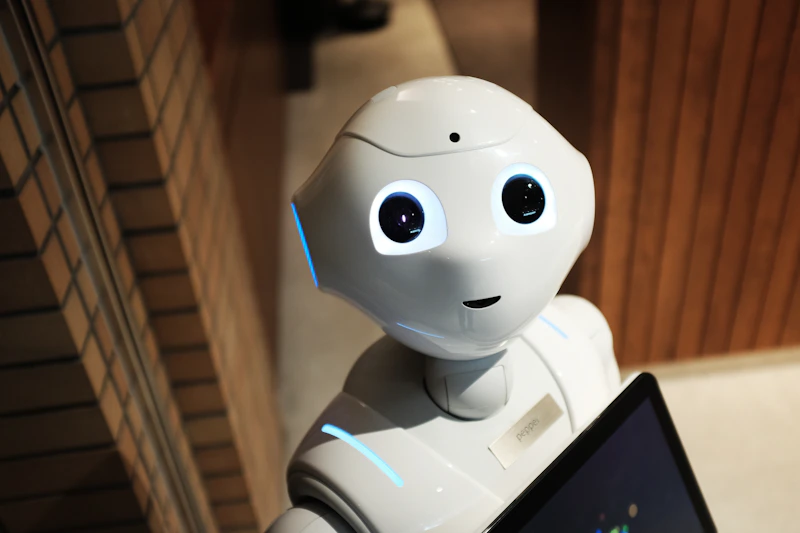
Source: Unsplash
The robots are here. They're loading planes, assembling cars, carrying packages. And most of them have a user experience designed by people who have never thought deeply about the humans working alongside them.
Humanoid robots are no longer science fiction. In 2026, they're shipping at scale, entering workplaces at an unprecedented rate, and the industry is celebrating the hardware breakthroughs. But there is a critical gap that almost nobody is talking about: the human side of this equation is broken. TrendForce projects global humanoid robot shipments will grow by over 700% this year. Figure AI's Figure 02 handled more than 90,000 parts at BMW's Spartanburg facility. Boston Dynamics launched the production version of Atlas at CES 2026, with 56 degrees of freedom and a 50kg lift capacity. Japan Airlines is deploying humanoid platforms at around $15,400 per unit for baggage handling and cabin cleaning. The race is on. But the interface layer, the way these machines communicate intent, build trust, and integrate into human workflows, is being treated as an afterthought.
"Robots have to prove themselves in the factory first, then they are allowed to do the housework in the home."
— Seunghyun Woo, Future Strategy Team Lead, Hyundai Motor Group, 2026
The Problem Is Not the Robot. It's the Relationship.
When product teams think about humanoid robots, they mostly think about hardware specs and AI capabilities. Can it lift 50kg? Can it navigate a warehouse without hitting anything? Can it learn a new task in under 10 minutes? These are real engineering problems, and they've made incredible progress.
What they're not asking: What does the robot look like when it's about to turn? How does a worker 20 feet away know if the robot is approaching them or moving in the other direction? How does a supervisor know when the robot is confused versus when it's executing a plan confidently? How does a warehouse manager see the state of 30 robots at once without a degree in robotics?
These are interface problems. They're not novel, either. Every product team building mobile apps, enterprise SaaS, or AI agents deals with some version of this. How does the user know what the system is doing? How does the system signal intent? How do you build trust through transparency over time?
The difference with humanoid robots is that the stakes are physical. A confusing UI in a SaaS product means someone calls support. A confusing robot in a BMW factory means someone gets hurt. The market for industrial humanoid robots is projected to reach $210 to $270 million in 2026, and the long-term trajectory goes much further, with analysts projecting 500,000+ units operational by the mid-2030s. At that scale, bad interaction design is not just a product problem. It's a public safety problem.
The Uncanny Valley Is a Design Problem
The uncanny valley is not new. Masahiro Mori described it in 1970. A robot that looks almost, but not quite, human triggers a deep discomfort response. Subtle imperfections in movement, expression, or timing become unsettling in ways that a clearly mechanical robot never would.
In 2026, the robotics industry is split on how to handle this. Some companies are leaning into hyper-realistic designs. The AheadForm Origin M1 head, for example, uses 25 micro motors beneath synthetic skin to generate lifelike micro-expressions and subtle glances, with cameras embedded in the pupils for visual perception. The theory is that human-looking robots will be more accepted in human-centric environments: eldercare, therapy, customer service, and companionship.
Other companies are deliberately avoiding human aesthetics entirely. Their robots have grey rubber faces, clearly mechanical frames, and no attempt at realism. These machines read as tools, not approximations of people, and that clarity actually builds more comfort in manufacturing and warehouse environments.
Both are valid strategies. The problem is that most teams are making this call based on what looks impressive in a demo reel, not on actual user research. Nobody is running systematic studies on which approach builds more trust in specific workplace contexts. Nobody is sitting down with warehouse workers, hospital staff, or factory supervisors and asking what makes them comfortable or uncomfortable.
I've seen this same pattern in enterprise SaaS design repeatedly. Teams build for the demo, not for the user. The product that impresses at a conference is rarely the product that works well for eight hours a day in a real environment. The robot that wins the design award at CES 2026 is not necessarily the robot that warehouse workers will actually trust and work alongside without anxiety.
The Operator Interface Nobody Is Talking About
Here's a specific problem that is getting almost zero attention in the robotics industry right now: how humans control and monitor humanoid robots is a disaster.
Most teleoperation interfaces today, the systems used to supervise or manually control humanoid robots, are designed for trained specialists. They're complex, cognitively demanding, and completely inaccessible to the average factory worker or facility manager. This creates a dangerous gap. The robots are being deployed in environments where the people responsible for them don't have the skills to effectively manage what they're doing.
A 2025 research paper specifically called out this gap, noting that most teleoperation research still targets trained specialists, despite the fact that real deployment happens in environments with non-expert users. The robots are smarter than ever. The interfaces for managing them haven't caught up.
This is a known failure mode in software product design. You build a powerful tool, you optimize it for power users, and then you deploy it to people who have never touched it before. The adoption numbers crater. The workarounds multiply. The product fails not because the technology doesn't work, but because nobody designed for the actual user who showed up.
What Good Interaction Design for Humanoid Robots Actually Looks Like
These are not theoretical principles. They're the same ones that work in any human-centered product design, applied to a physical context:
- Legible intent: The robot should communicate what it's about to do before it does it. Not to every person in the building, but to the humans in its immediate environment. This is a design problem, not an AI problem. A simple LED color system or directional audio cue is enough. Most current robots do nothing.
- Graceful failure modes: When the robot is confused or stuck, it should show this clearly. A robot that stands silently with no visible indication of its state is terrifying to work next to. A robot that displays a visible "needs help" signal, in a way any worker can recognize, is manageable. This is basic feedback design.
- Minimal training requirements: Interfaces designed for expert operators will fail when deployed at scale. The goal should be natural language commands, simple visual dashboards, and interfaces that a person can understand in under 10 minutes on their first day.
- Trust-building transparency: Trust is a relationship that develops over time. Robots deployed in workplaces should surface their own reliability metrics. Something like "I completed 2,340 tasks this week with 99.1% accuracy" gives workers and managers a concrete basis for trust decisions, instead of asking them to guess.
- Clear worker agency: Workers who feel they have no control over robot behavior become anxious and resistant to the whole program. Interfaces that give workers understandable override mechanisms and clear explanations of robot decisions reduce this significantly. The IEEE survey data from early 2026 confirms this: gradual pilot programs with clear communication had significantly higher worker acceptance rates than abrupt deployments.
Worker Anxiety Is a Communication Design Failure
The IEEE published a survey in early 2026 showing that workers in environments where humanoid robots are being introduced have two primary concerns: job displacement and physical safety. Both are legitimate. Both are also, at least partially, design problems.
Job displacement anxiety is not something a robot interface can solve on its own. But the way robots are introduced into workplaces, and the way their role and limitations are communicated, significantly affects how workers respond. Companies that deploy robots without clear communication design, without giving workers a coherent mental model of what the robot does and does not do, are not managing a technology challenge. They're failing at communication design.
Physical safety concerns are more directly tied to interface decisions. Workers need to be able to predict robot behavior. They need clear spatial signals, clear intent communication, and intuitive emergency stop mechanisms that any worker can activate without training. These are not impossible. They are solvable with the same methods that work in any safety-critical product: research, iteration, and testing with real users in real environments.
The IEEE data shows something that should not be surprising to any product designer: workers who experienced robots through gradual pilot programs with clear communication had significantly higher acceptance rates than those where robots were deployed without context. The technology was identical. The integration design was different. That's the whole story.
What This Means for Product Teams Right Now
If you're a product designer or product manager in 2026, humanoid robots might feel like someone else's domain. I'd argue they're not, and here's why.
The companies building humanoid robots right now, Figure AI, Tesla, Boston Dynamics, 1X Technologies, Unitree, are all actively hiring product designers and AI UX specialists. They're starting to figure out that the bottleneck is not the hardware or the AI model. It's the interface layer. I wrote about this pattern on Medium in my piece on AI-native experiences and the 14 mindset shifts product teams need to make. The core lesson applies here directly: the technology is not the product. The experience of using the technology is the product.
A humanoid robot with brilliant AI, precise motors, and a terrible interaction design is not a good product. It's an expensive liability. The companies that figure out the interface layer first, that prioritize legibility, trust, and worker agency from day one, will win this market. Not because of better motors or better model weights, but because their robots actually work when deployed in front of real humans in real environments. That's a lesson the enterprise SaaS world learned the hard way over two decades. The robotics industry is about to relearn it.
A few companies worth watching closely as this plays out: Figure AI has the most mature real-world deployment data from BMW. 1X Technologies is designing explicitly for human coexistence from day one. Boston Dynamics is making the hard transition from research robot to production tool, and that transition will reveal exactly how much the design layer matters.
What do you think? Are the companies building humanoid robots thinking seriously enough about the interface layer? Have you seen good examples of human-robot interaction design in the wild? Drop your thoughts in the comments below. I would genuinely love to hear perspectives from people in manufacturing, robotics, or product design.
Sources:
1. TrendForce — Humanoid Robot Market Forecast 2026
2. Figure AI — BMW Spartanburg Deployment Data, 2026
3. Boston Dynamics — CES 2026 Atlas Production Launch
4. The Robot Report — IEEE Survey on Humanoid Robots in the Workplace, 2026
5. KraneShares — Humanoid Robotics: The Race From Pilot to Platform, 2026
6. RoboticsTomorrow — "The Missing Interface: Designing Trust into a Robotic Future," August 2025
7. arxiv.org — "Development of an Intuitive GUI for Non-Expert Teleoperation of Humanoid Robots," 2025